
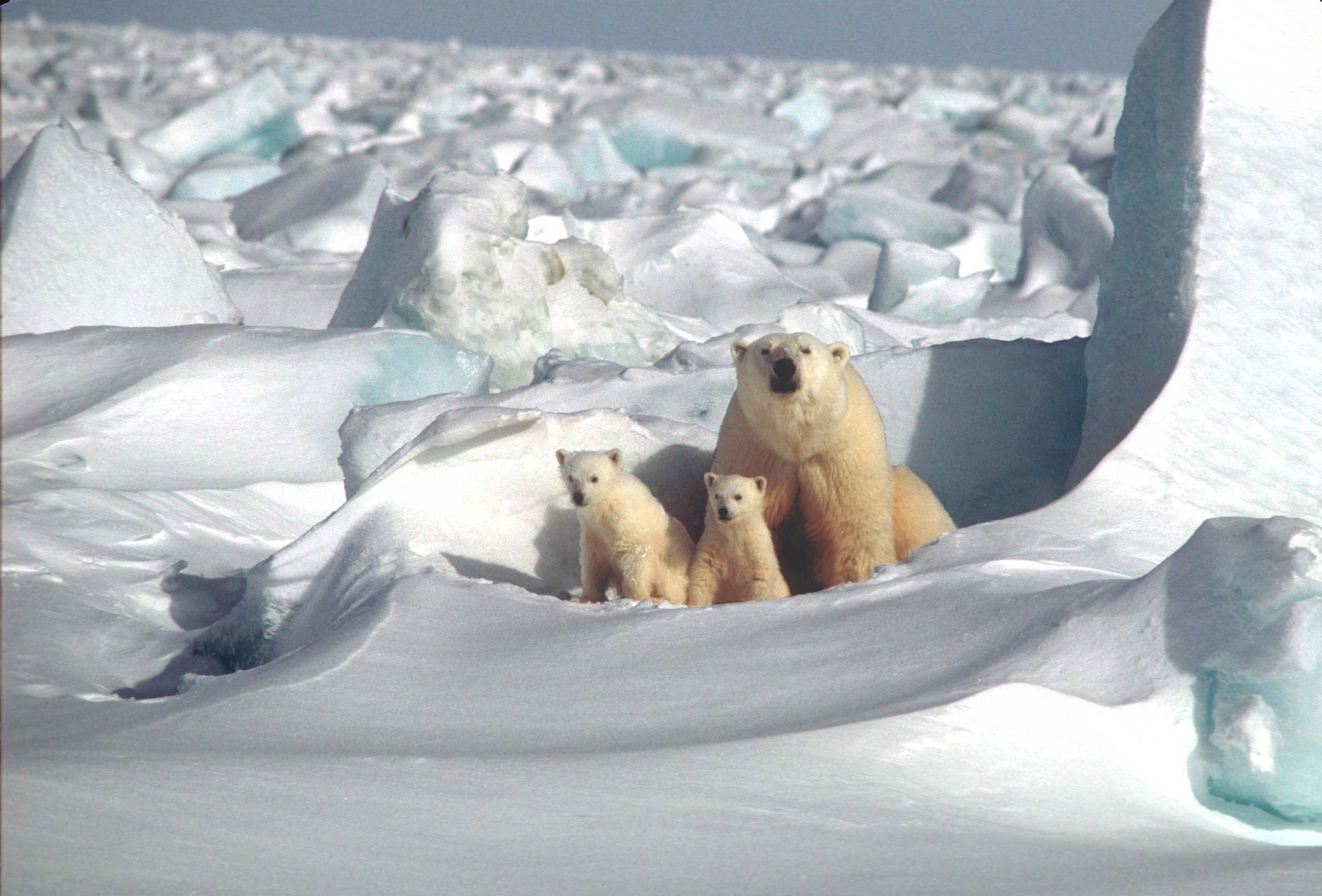
A mother and two cubs on Beaufort Sea ice. This photograph illustrates the bears’ ice habitat; it does not show the western Hudson Bay study animals. Photo: Steven Amstrup/USGS, Alaska Science Center.
On September 8, 2022, a polar bear lay on land in Canada’s Wapusk National Park, looking out at the coast. A research camera recorded the view. In another sequence, an adult female ate berries. Both belong in the same portrait of a marine mammal: a polar bear can make use of what it finds on shore, but its richest hunting ground is out on the frozen sea.
What the ice gives a bear
A seal has to surface for air. On sea ice, a bear can wait beside a seal’s breathing hole and strike when it comes up. Ringed seals are its principal prey; bearded seals also provide food. A successful hunt offers something that is hard to come by on the tundra: a meal rich in fat.
Near Churchill, Manitoba, that access comes and goes with the seasons. Hudson Bay’s ice breaks up, bears spend time ashore, and in autumn they gather along the coast waiting for ice to form again. A bear resting on land can be part of that normal seasonal rhythm. The concern is how long it must live on its reserves before it can hunt again.
Polar Bears International chose November 1–7 for its 2026 Polar Bear Week because it coincides with that gathering. The organization reports that the local ice-free period lasts roughly three to four weeks longer than it did in the 1980s. A longer season on land leaves less time to build up fat reserves on the ice. The timing is specific to this coast; conditions vary around the Arctic.
Can a polar bear find enough food on land?
In a study published in 2024, Anthony Pagano and colleagues followed 20 different bears in western Hudson Bay. They measured movement, energy use and changes in body mass over stretches of 19 to 23 days in late summer. The collar-camera footage gives a sense of how different those days could look: one bear fed on a bird carcass; another swam near a dead beluga. Others spent long periods resting.
The weigh-ins told a story the cameras alone could not. Nineteen of the 20 bears lost body mass during observation. The bears tried a range of ways to feed or conserve energy, yet for most, what they found on land did little to extend the time they could go without returning to the ice.
That result is narrower, and more useful, than a prediction about every polar bear. The researchers studied a particular group over a few weeks. A camera can show what a bear ate. Weighing it again can show whether, over those weeks, it took in enough energy to maintain its mass.
Where bears and people meet
In Churchill, the wait for ice is also part of daily life for people. After a fire damaged the town’s waste facility in 2024, it had to rely on a landfill where garbage attracted bears. A bin lid or a fence can sound like an unlikely subject for an ocean conservation campaign. For someone who has to take rubbish out or work at the facility, keeping a bear from finding food there is a practical safety measure.
Polar Bears International reports buying 38 bear-resistant waste containers and working with the town on power, lighting and electric fencing at the landfill. In an October 30, 2026 update, it also described a camera under development to recognize approaching bears and alert people. A closed, bear-resistant bin keeps that food out of reach. An alert could give staff time to respond. Neither makes the bay freeze sooner, and the new camera’s potential should not be mistaken for a demonstrated reduction in encounters.
People who live with bears are in the best position to say which measures fit their town. A camera needs someone to receive its alerts; a bin needs to work for the people emptying it. Those are good questions for a supporter to ask before proposing a new piece of equipment.
A way to help from far away
One place to start is with the research footage itself. Watch the bear eating berries, then ask a class, a team or a family what else they would need to know before calling it a good day’s feeding. A second weigh-in would tell you more about how the bear fared over the whole observation period. It is a small exercise in reading wildlife images carefully, whether they show an apparently thriving bear or one that looks thin.
For people who want to give, the October 30 announcement describes a Polar Bears International fundraiser planned for November 24–December 2. Its aims include buying eight additional bear-resistant bins for Churchill. Check the organizer’s current details and give through its own channels. Eight bins is a fundraising goal, not eight installations already delivered. This is an external initiative, not a WOL campaign.
A company team could match employee gifts to a confirmed community request; an athlete could use a short interview to let a local practitioner explain the work. The first conversation should be with the people doing it, about whether they want that support and what they could use. An audience can count contributions to a bin purchase. The community and its researchers are the ones who can assess what changes once the bin is in use.
Keeping food waste out of reach helps on shore today. Protecting the sea ice bears need over their lifetimes also depends on limiting warming. Both matter to the animal waiting at the water’s edge.
Put the plan into practice.
Explore a scoped 90-day corporate ocean program, with responsibilities and reporting agreed before work begins.
Explore the corporate programFor individual participation, join the free WOL network. For an evidence framework, read A practical ocean scorecard.