
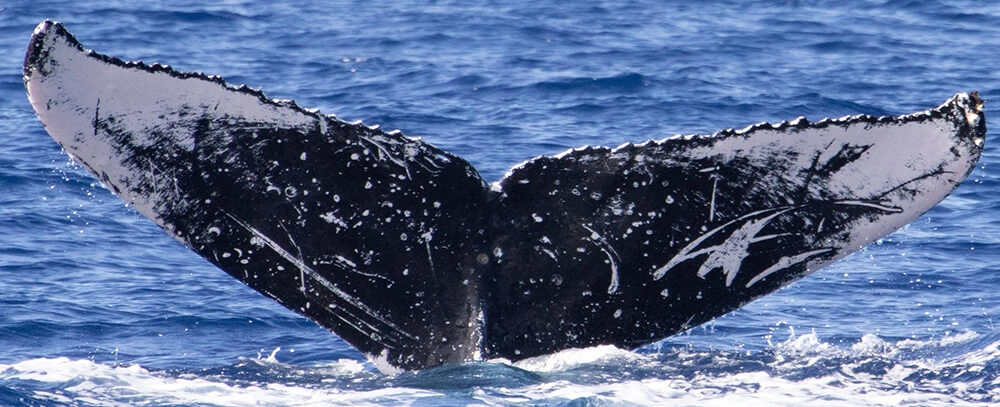
Humpback fluke markings photographed under a research permit. Illustrative photograph, not the whale in the rescue account below or a WOL activity. Photo: Maria Harvey/NOAA, Permit #24359.
A whale raises its tail, water falls from the trailing edge, and the animal disappears. To a passenger watching from a boat, the photograph may be a memory of a few remarkable seconds. To a researcher comparing it with earlier images, the same frame can help answer a different question: have we seen this individual before? The value lies not only in the photograph, but in the careful record around it.
A pattern that connects encounters
Humpback whales carry distinctive combinations of pigmentation, shape, and scars on their tail flukes. NOAA Fisheries explains that these features help researchers identify individuals. A useful image can therefore become part of a record that follows one whale between encounters, without requiring the photographer to attach a tag.
In its March 19, 2026 account of humpback monitoring, NOAA describes how researchers and members of the public contribute fluke photographs to Happywhale. The platform combines automated image matching with human expertise. Connecting sightings can help scientists study movements and habitat use; with suitable analysis, individual encounter records can also contribute to estimates of survival and population size.
That does not make every attractive whale image equally useful. A distant splash, a back breaking the surface, and a clear view of the underside of the tail offer different information. The receiving research project’s requirements matter more than the photograph’s appeal on a screen.
One photograph, seven years later
A NOAA account published in June 2025 gives the method a human scale. In 2017, a young humpback off Maui had become entangled in hundreds of feet of coaxial cable. Authorized responders freed it, although some cable embedded in its mouth could not safely be removed. Seven years later, the whale was photographed again off Maui, and the image was uploaded to Happywhale.
The photograph allowed researchers to confirm its identity. NOAA reported that no remaining gear or visible injury was evident at the later encounter. The sighting supplied something the original rescue could not: evidence that this individual was alive years afterward.
The distinction is important. One re-sighting is valuable evidence about one whale. It is not a survival rate for all disentangled whales, proof that every rescue succeeds, or a complete assessment of the animal’s health. A compelling story becomes stronger when its limits remain visible.
A sighting is not a census
A collection of photographs records encounters, not every whale in the sea. Before interpreting it, ask where observers were looking, when they were there, and whether repeated images show the same animal. More uploads could reflect more photographers or greater use of a platform. They should not automatically be described as an increase in whales.
NOAA’s 2026 monitoring overview brings photo-identification together with vessel surveys, observations from shore, and underwater sound recordings. It describes community shore counts as snapshots rather than a complete census. Different methods answer different questions, and their combination can provide context that an isolated photograph lacks.
For readers, a useful habit is to separate the observation from the conclusion. “This identified whale was photographed here on this date” is narrower than “this population is recovering.” The second statement needs an appropriate study, not simply a striking first statement repeated at scale.
Start with photographs you already have
Useful participation need not begin with another trip. If you already hold whale photographs, look for a research program that accepts images from the relevant species and region. NOAA’s account points to Happywhale as one route for humpback contributions. Check the recipient’s current instructions before submitting; do not assume any image will be usable or matched.
Keep the original file and preserve the date and location of the encounter. Explain uncertainty rather than supplying a precise location you cannot support. Keep a sequence together so the recipient can understand that several frames may belong to one encounter. If the photograph belongs to someone else, obtain the necessary permission before sharing it.
These are practical record-keeping suggestions, not a substitute for a project’s protocol. Let the receiving team decide how a contribution can be used. An unmatched image is not evidence of a newly discovered whale, and submitting a file does not establish that it has entered a scientific analysis.
The whale comes before the photograph
Never pursue a closer encounter to improve a submission. NOAA’s general viewing guidance recommends keeping at least 100 yards from large whales, while species-specific and local rules may require greater distances or other precautions. Check the rules for the place and species before going out; that general distance is not universal legal permission to approach.
Do not chase, surround, or move ahead of a whale to intercept it, and do not separate a mother and calf. If an animal appears entangled or distressed, report it to the appropriate local wildlife-response authority from a safe distance. The Maui story involved trained, authorized responders. It is not an invitation to attempt a rescue.
Support the work around the image
For a company, a sensible starting point is to ask an established research organization what it actually needs. A bounded contribution could involve organizing existing, permission-cleared images or supporting an agreed data-management task, but only if the recipient wants that help and can supervise it. Do not invent a volunteer role simply because it makes a good team activity.
Within WOL’s scoped 90-day corporate program, an appropriate goal would be to define a useful role, agree responsibilities, and document what was completed. That period is a planning and delivery window, not a deadline for demonstrating whale-population recovery. No research partner or field activity is promised by this article.
Record participation, accepted contributions, and scientific findings separately. A folder of uploaded photographs is an output; a documented match is a different result; a conclusion about a population needs its own evidence. For individuals and companies alike, the most constructive contribution begins with attention: to the animal, to the record, and to the people who can make responsible use of it.
Put the plan into practice.
Explore a scoped 90-day corporate ocean program, with responsibilities and reporting agreed before work begins.
Explore the corporate programFor individual participation, join the free WOL network. For an evidence framework, read A practical ocean scorecard.