
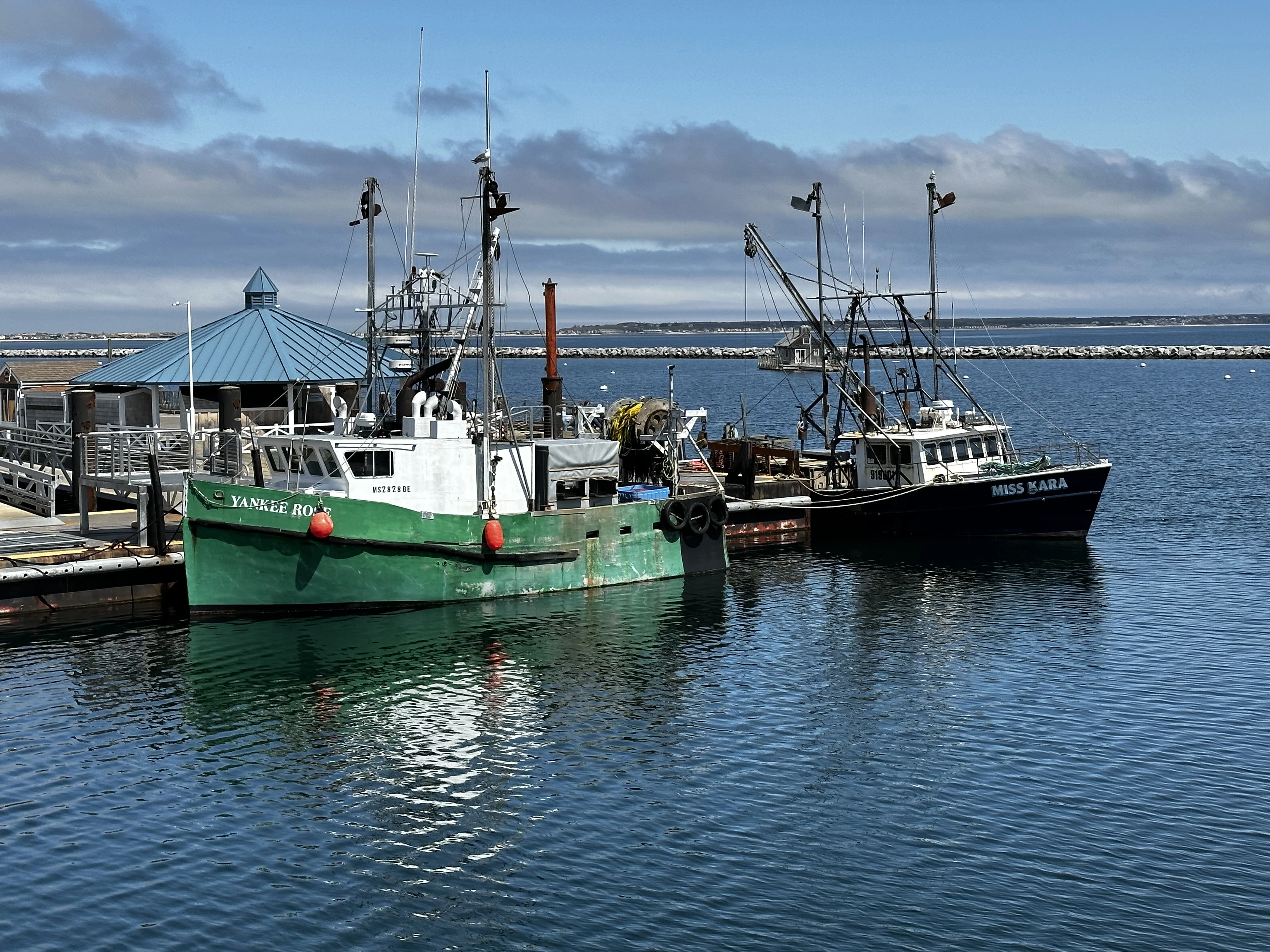
MacMillan Pier, Provincetown, Massachusetts, April 24, 2023. Illustrative working-waterfront photograph; not a WOL project. Photo: NOAA Fisheries.
Seafood’s future is about feeding people while sustaining the waters and communities that produce it. Wild fisheries, aquaculture, and international trade all have a role. The challenge is to make that food system more resilient without confusing higher production with better outcomes.
A food system with global consequences
Fish on a plate connects a consumer to a much larger system: ecosystems, vessels, farms, landing sites, processors, transport, and people whose livelihoods depend on each link. The future of seafood will be shaped by how that system produces food, who can afford it, and whether the resources behind it remain productive.
FAO’s State of World Fisheries and Aquaculture 2026 reports that aquatic animal production reached 195 million tonnes in 2024. Aquaculture contributed 103 million tonnes, exceeding capture fisheries. These are global figures covering marine and inland production; they should not be read as a measure of food taken from the ocean alone.
The same assessment says aquatic animal foods supply at least one-fifth of animal protein consumption for 3.1 billion people. That makes the subject much larger than a restaurant preference. Decisions about fisheries, farming, and trade affect nutrition, jobs, and communities across borders.
Wild fisheries: productivity depends on management
FAO reports that global capture production has remained within a relatively narrow range since the late 1980s. More demand cannot simply be met by assuming boats can bring home ever larger catches. The condition of the resource matters, as do the rules and practical capacity that govern access to it.
NOAA describes sustainable seafood in terms of protecting the long-term health of populations and ecosystems. Its U.S. fisheries work combines scientific monitoring with regional management. For a buyer, the useful implication is to ask about a particular species, fishing area, and fishery rather than treating all wild-caught seafood as one category.
The evidence behind a purchasing decision can change. A familiar species name tells only part of the story: suppliers should be able to explain where the product originated and what information supports their claims. A confident label is less useful than a traceable product and a clear account of the fishery supplying it.
Aquaculture is already part of the answer
Aquaculture is not one technology. NOAA defines it as breeding, raising, and harvesting aquatic plants and animals; marine production can take place in coastal waters or in land-based systems. Shellfish cultivation, finfish cages, and recirculating tanks involve different organisms, inputs, and operating decisions.
Growth creates possibilities, but it also makes the details important. NOAA’s environmental guidance identifies issues including disease interactions, uneaten feed and fish waste, and escapes. Siting, husbandry, containment, and monitoring help address those risks. A farm’s species, location, and management are more informative than a blanket judgment about all farmed seafood.
Feed is another part of the picture. NOAA describes work to reduce reliance on fishmeal and fish oil through alternative ingredients and the use of processing trimmings. That is an example of a practical improvement to investigate, rather than grounds for assuming that every farm has solved its resource challenges.
The useful question is how an operation performs within its setting. Buyers can ask suppliers to identify the production system and explain which environmental conditions are monitored, what standards apply, and what happens when a problem is detected.
The people behind the supply
An abundant harvest does not automatically mean affordable food or secure livelihoods everywhere. FAO’s 2026 assessment describes uneven access to aquatic foods and stresses more inclusive development. Its framing puts communities and the efficiency of supply chains alongside production.
NOAA likewise treats fishing communities’ livelihoods, cultural practices, and nutrition as part of seafood sustainability. A working waterfront needs more than fish in the water. It also needs people with skills, practical infrastructure, and businesses capable of handling and selling the catch.
For companies buying seafood, those connections are worth understanding. A purchasing conversation can include the origin of the product, the businesses handling it, and the information that travels with it. The aim is to make decisions that suppliers can substantiate, while recognizing that a small producer may need support to improve documentation rather than another vague demand for a sustainability story.
A changing ocean requires better information
FAO identifies climate change and environmental degradation among the pressures facing fisheries and aquaculture. That adds uncertainty to a sector already dealing with economic shocks and complex international supply chains. Historical performance remains useful, but it cannot guarantee future conditions.
This is where ocean science becomes directly relevant to food. Monitoring can help people understand changing conditions and make better decisions. Credible progress involves records that can be checked over time, clear responsibilities, and the ability to adjust when the evidence changes.
Traceability has a related role. NOAA describes seafood mislabeling and fraud as supply-chain problems ranging from missing information to deliberate deception. Better records can help establish what a product is and where it came from. They do not, on their own, prove that every environmental or social issue has been resolved.
What a useful contribution looks like
Individuals can start with a few concrete questions: what species is this, where was it caught or farmed, and can the seller explain the source? For a company serving food at events or in a workplace, the same questions can become part of a conversation with its caterer or supplier. The point is to make purchasing more informed, not to promise that one menu choice repairs an ecosystem.
Company teams can also explore a defined contribution to ocean learning, a confirmed monitoring need, or an appropriate community initiative. WOL’s scoped 90-day corporate program can organize agreed participation and reporting once responsibilities and delivery capacity are confirmed. It does not certify seafood or guarantee changes in fish populations.
A closing account should distinguish what the team did from what scientists or managers can demonstrate. Training delivered, funds transferred, and records accepted by a project are useful outputs. Evidence of a healthier fishery requires its own methods and timescale.
The future of seafood will depend on productive ecosystems, capable producers, and informed decisions throughout the supply chain. Supporting those foundations gives ocean conservation a direct connection to everyday life: the food people eat and the communities that make it available.
Put the plan into practice.
Explore a scoped 90-day corporate ocean program, with responsibilities and reporting agreed before work begins.
Explore the corporate programFor individual participation, join the free WOL network. For an evidence framework, read A practical ocean scorecard.