
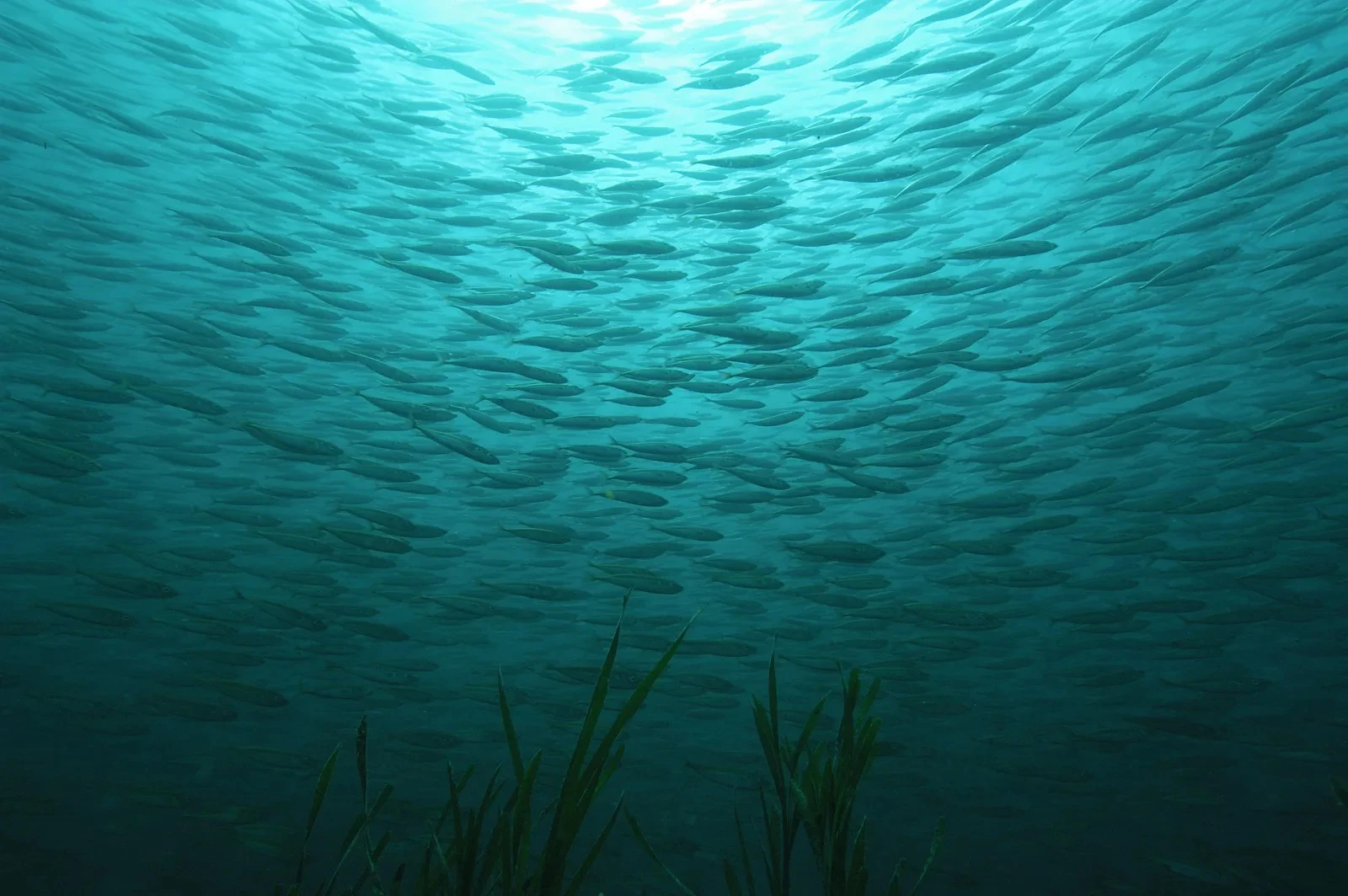
Fish above eelgrass in Channel Islands National Marine Sanctuary, California. Illustrative habitat photography; this is not the Virginia restoration site or a WOL project. Photo: Robert Schwemmer/NOAA.
An eelgrass meadow is easy to overlook from the shore. Beneath shallow coastal water, its long leaves create a place where young fish can shelter and other animals can feed. Bringing that habitat back takes more than putting plants into the sea. Virginia’s coastal bays offer a useful example of what can happen when suitable conditions, scientific work, and sustained local participation come together.
A meadow made of flowering plants
Eelgrass is a seagrass: a flowering plant adapted to marine life. It is different from the algae that form kelp forests. NOAA Fisheries describes eelgrass as habitat that shelters juvenile fish, provides feeding areas, helps stabilize shorelines, and supports water quality. Its position near shore also exposes it to changes in water quality, coastal development, and vessel activity.
That combination matters for anyone interested in restoration. The plant is part of a living coastal system, and the conditions around it influence whether it can persist. A successful planting technique cannot, on its own, answer questions about the water, the site, or the pressures that caused a meadow to disappear.
What made Virginia’s recovery possible
In its October 7, 2020 account of research published in Science Advances, the Virginia Institute of Marine Science described a restoration effort that began seeding the Eastern Shore’s seaside bays in 1999. Those bays had lost their eelgrass following disease and a hurricane in the 1930s. The researchers identified a crucial distinction: suitable conditions remained, but too few seeds were reaching these isolated waters to restart recovery.
Scientists and volunteers supplied seeds, then continued the work over years. VIMS reported that more than 70 million seeds had been broadcast and that the expanding meadows covered almost 9,000 acres by the time of its 2020 account. Those are historical project figures, not a new survey of the area today.
VIMS also reported gains in fish and invertebrate abundance and water clarity. Its explanation connected the outcome to suitable water quality, the scale of seeding, and long-term research and monitoring. The result illustrates why understanding the original cause of loss belongs at the beginning of a restoration plan.
Wildlife recovery needs its own evidence
The return of grass opens another question: which animals return, and under what conditions? In Virginia, bay scallops became the focus of a separate restoration effort. A VIMS update dated October 8, 2025 reported growing scallop populations in the restored meadows and an average density of 0.114 scallops per square meter in its 2025 survey.
That update describes dedicated scallop production and release work alongside the recovering habitat. It should not be read as evidence that scattering eelgrass seed automatically restores every species. The research team attributed progress to several factors, including the eelgrass habitat, favorable water quality and weather, and the work of staff and supporters.
For a reader or potential funder, the distinction is useful. Meadow coverage, fish abundance, and scallop density are different observations. A report should identify what was measured, when, and by whom. One encouraging number should not stand in for the condition of an entire ecosystem.
The local conditions still decide
Virginia’s example is not a recipe that can be copied unchanged onto every coastline. VIMS’s restoration overview describes less durable results in parts of Chesapeake Bay, where poor water quality and increasing temperatures are likely constraints. It also describes research on why young seedlings fail to establish, including the effects of waves and currents.
A useful first conversation with a restoration practitioner therefore begins with the site: why was the habitat lost, what has changed, and what evidence suggests that recovery can last? Protecting an existing meadow or addressing a pressure on it may be a more useful role than proposing a new planting day. The choice belongs with the people who understand and manage the place.
Where participation fits
The Nature Conservancy’s account of the Virginia project shows a practical volunteer role within a longer scientific process. Participants collect reproductive eelgrass shoots containing seeds. Those shoots go into holding tanks; seeds are separated, stored, and later sown. The visible collection day is one stage of work that continues afterward.
Anyone interested in taking part should use the organizer’s current volunteer information and confirm timing, access, equipment, and suitability. Seed collection depends on the plants’ seasonal development. An older project story is not confirmation that a trip is available now. Avoid collecting or transplanting seagrass independently; follow the local program’s instructions and permissions.
Companies can use the same principle when considering support. Ask a practitioner which part of the work needs resources, whether the group can usefully participate, and what records will be available. Support might involve staff time, an agreed equipment need, or monitoring rather than a large event. Each commitment should match the recipient’s capacity and priorities.
A useful role for a 90-day program
For WOL’s scoped corporate program, 90 days can provide a period to define an initiative, agree responsibilities, organize suitable participation, and document completed work. It is not a biological deadline for a seagrass meadow to recover. Any field activity would need a confirmed delivery organization, permissions, and a scope agreed before it begins.
A closing account can record funding transferred, work completed, participation, and the next monitoring milestone. Claims about habitat recovery need the relevant field evidence over time. Carbon claims would require their own substantiation; funding a habitat activity does not, by itself, establish a quantity of carbon removed or an offset.
For individuals, learning to recognize a local habitat and following the work of its stewards is a useful starting point. For businesses, the opportunity is to support a defined part of that work consistently. Virginia’s story makes the value of that patience visible, while leaving room for the evidence still to come.
Put the plan into practice.
Explore a scoped 90-day corporate ocean program, with responsibilities and reporting agreed before work begins.
Explore the corporate programFor individual participation, join the free WOL network. For an evidence framework, read A practical ocean scorecard.