
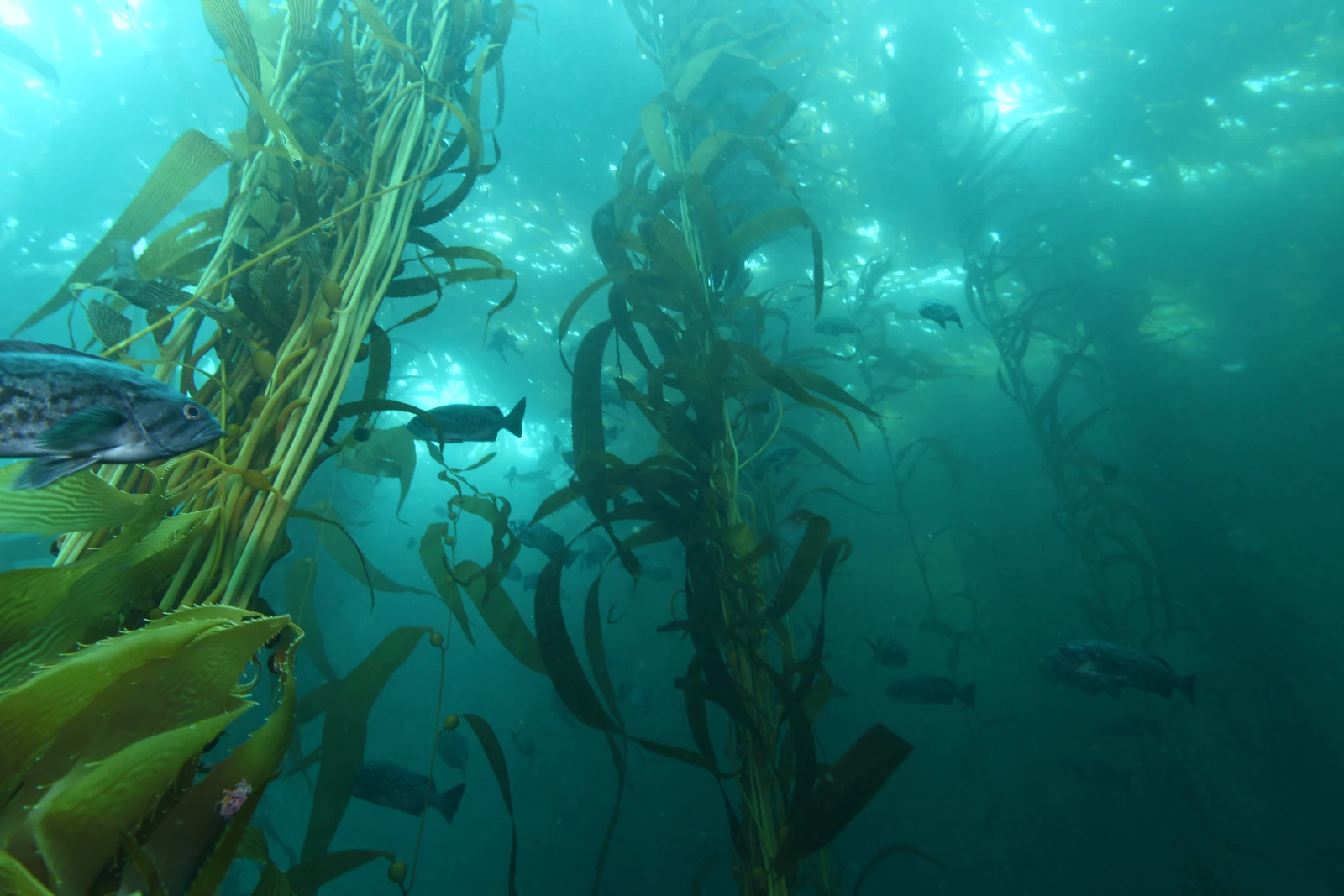
Kelp habitat in Monterey Bay National Marine Sanctuary. Illustrative photography, not a restoration result or WOL project. Photo: Chad King/NOAA.
A kelp forest is a living habitat shaped by what grows, what grazes, and what eats the grazers. California’s recovery story is now bringing those relationships into sharper focus. Breeding sunflower sea stars and finding survivors in the ocean are encouraging developments. Understanding what they mean requires separating a research milestone from evidence that an underwater forest has recovered.
Why kelp can struggle to return
NOAA’s June 25, 2026 account of California’s kelp ecosystems describes several pressures acting together: sea star wasting disease, unusually warm water, and loss of kelp canopy. Sunflower sea stars are predators of sea urchins. Their decline weakened one of the checks on grazing at the same time that ocean conditions were putting kelp under stress.
Purple urchins belong in these ecosystems. The problem is sustained, excessive grazing that can suppress new kelp growth. NOAA describes restoration teams testing targeted urchin removal and tracking the response. Some sites have shown increased kelp density and canopy cover, including plants reaching reproductive maturity. Results vary, and large-scale ocean conditions remain beyond the teams’ control. Those observations support continued investigation; they do not establish a single solution for every stretch of coast.
What breeding sea stars has achieved
In its December 18, 2025 feature, NOAA Fisheries reported that the Pacific Coast Ocean Restoration Initiative was helping institutions rear juvenile sunflower sea stars and study their behavior and genetics. Birch Aquarium’s February 2024 spawning supplied larvae to California teams. Learning how to feed and raise the young animals was an essential step toward building a conservation breeding program.
The same report described work to preserve genetic diversity and investigate disease resistance. It also stressed that substantial work remained before reintroduction. Its estimate of five or more years before outplanting was a research outlook given in December 2025, not a confirmed release date. Successfully raising animals under human care does not by itself demonstrate survival, reproduction, or a beneficial effect on kelp after release.
What the 2026 reports add
NOAA’s June 9, 2026 field account reported 18 sunflower sea stars found during a coordinated search called Pycnopalooza. The search involved Sonoma State University, the Kashia Band of Pomo Indians, Greater Farallones and Cordell Bank National Marine Sanctuaries, and Greater Farallones Association. Finding surviving animals offers researchers a better starting point for understanding where the species persists.
A separate NOAA update on June 25, 2026 described an environmental DNA method that detects genetic material shed into seawater. Researchers assessed 39 California sites and detected sunflower sea stars at six distinct sites in Mendocino, Sonoma, and San Mateo counties. The update also described a detection in Noyo Bay followed by a diver’s sighting of a juvenile.
These findings answer a presence question. They do not, on their own, establish the size or long-term viability of a population, or show that kelp at a detection site has recovered. The next useful account connects repeated observations with the condition of the surrounding habitat.
How to read a restoration claim
For a reader or prospective supporter, the most useful question is: what was actually measured? A breeding record, a confirmed sighting, a survey of kelp canopy, and a record of urchins removed each describe something different. None should quietly substitute for the others.
WOL’s suggested approach is to ask for a baseline, a named location, the monitoring dates, and an explanation of the method. Ask whether the result comes from one plot or several sites, whether a comparison area was observed, and whether monitoring continued after the initial work. A carefully bounded result is easier to understand and use than a large claim with no clear unit or timeframe.
It also helps to ask what did not change. A project may improve its breeding methods while field release remains a future objective. A restoration plot may improve while nearby habitat does not. Recording those differences makes the evidence more useful for the next decision.
A useful role for people and companies
Individuals can begin by following the work of local aquariums, researchers, and established conservation organizations. The NOAA Fisheries feature relays Greater Farallones Association’s advice to people who encounter sunflower sea stars to leave them untouched and report sightings through iNaturalist. That is a specific observational contribution, not an invitation to move animals or attempt an independent restoration experiment.
For a company, a useful brief might focus on supporting an organization’s confirmed research needs or a learning program it has the capacity to deliver. Ask the prospective recipient what support is useful before designing an employee activity around it. Treat access, supervision, permissions, and the evidence plan as part of the scope.
WOL’s proposed 90-day corporate program provides a framework for agreeing on one initiative, participation, communications, and a closing evidence report. A 90-day engagement is a management period, not a promise that an ecosystem will recover within that time. Delivery partners, availability, costs, and responsibilities must be confirmed separately. No kelp restoration partner or field activity is being offered as already contracted.
Keep the next step proportionate
The kelp story gives people a reason to pay attention and a way to ask better questions. A first contribution can support learning, a clearly defined piece of work, or the collection of evidence. The closing account should say what happened, what remains uncertain, and what should be examined next. That is a constructive basis for sustained participation.
Put the plan into practice.
Explore a scoped 90-day corporate ocean program, with responsibilities and reporting agreed before work begins.
Explore the corporate programFor individual participation, join the free WOL network. For an evidence framework, read A practical ocean scorecard.