
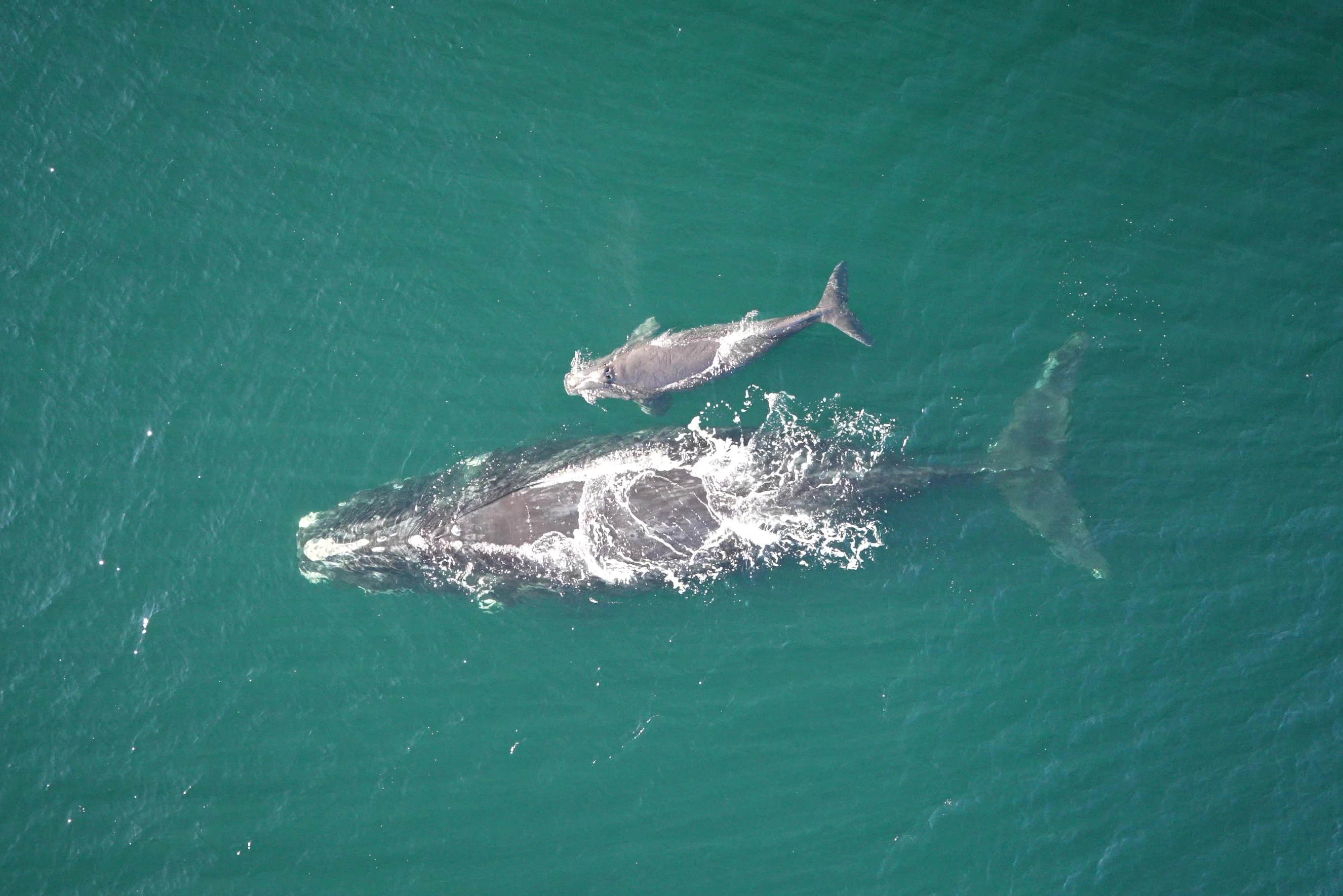
North Atlantic right whale Magic (#1243) and her calf, photographed by a NOAA research drone in the southeastern United States. This pair is distinct from Silt and her calf, whose discovery opens this story. Photo: NOAA Fisheries/Isaac Benaka, Permit #27066.
A whale called Silt has given conservationists a new reason for hope. Her recently documented calf is a reminder that the North Atlantic right whale’s story is still being written—and that helping the next generation survive matters as much as celebrating its arrival.
A new calf, and a family worth knowing
On November 2, 2026, the New England Aquarium announced that researchers had identified a previously unknown mother-calf pair. Mingan Island Cetacean Study photographed them near Anticosti Island, Quebec, on September 25. Comparing those images with the North Atlantic Right Whale Catalog confirmed the mother as Silt, at least 38 years old, with her sixth known calf.
The researchers believe the calf was born during the 2025–2026 season but missed by winter surveys. The discovery raised that season’s known total from 23 to 24. It was a new observation, not evidence of a September birth.
Silt’s family makes the stakes personal. The Aquarium reports that she has survived at least five entanglements. Her 2022 calf, Division, died following a severe entanglement in 2026. Hope and loss belong in the same account: a calf is a beginning, not a guarantee of a long life.
An extraordinary animal, hiding in plain sight
North Atlantic right whales can reach 52 feet in length. They have broad bodies, no dorsal fin, and distinctive rough patches on their heads called callosities. Those patterns let researchers recognize individuals. A photograph can connect a whale seen today with a life followed across decades.
These enormous animals feed on tiny plankton, filtering seawater through baleen. Their lives connect the southeastern United States’ calving waters with feeding areas farther north, including Canadian waters. They are a different species from southern right whales and North Pacific right whales; photographs and statistics should never treat them as interchangeable.
That individual identity is a powerful starting point for public storytelling. An animal with a name, a history, and a family is easier to understand than an anonymous silhouette beside an alarming number. The responsibility is to tell that history accurately, without turning a researcher’s observation into an invented adventure.
How many are left?
The dated population estimate used here is 384 whales at the start of 2024, with a 95 percent credible interval of 375 to 394, reported in NOAA’s 2025 technical assessment. It is an estimate for a particular year, not a live headcount on the day you read this article.
The assessment describes a slowing of the sharp decline seen during 2015–2020, while warning that mortality remains above recovery thresholds. The recent calf discovery is encouraging, but adding 24 calves to an older population estimate would produce a misleading total: births, deaths, survey coverage, and revised estimates all matter.
For a public campaign, honest numbers make the story stronger. A dated estimate and an explanation of what it means give supporters something dependable to share. Recovery must be judged across years, with attention to survival and reproduction, rather than through the success of one season or one fundraising event.
The people helping them survive
NOAA identifies fishing-gear entanglement and vessel strikes as leading causes of death. Changing ocean conditions and noise add pressures. Protecting whales therefore requires practical work in the waters they use, as well as continued research and effective conservation measures.
That work includes people looking from aircraft and vessels, scientists comparing photographs, and teams listening underwater. NOAA’s acoustic monitoring can detect calling whales when visual surveys are less effective. Photographs, locations, and observations also help scientists study health, behavior, and changing distribution.
Behind a memorable whale photograph is a less visible commitment to collecting and maintaining records. These are useful stories to bring into public view: the patience of a survey team, the recognition of a familiar mother, and the care required to turn a sighting into reliable knowledge.
What a campaign could make possible
A credible campaign could invite people to follow a whale’s documented story, meet the researchers through an agreed interview, and support a clearly identified conservation need. Corporate funding might support an organization’s confirmed monitoring or education work. An athlete or public figure could introduce that work to an audience that would otherwise never encounter it.
Those are proposals, not announcements of WOL partners or celebrity commitments. Before fundraising, the recipient should confirm the need, capacity, permitted use of its name and imagery, and how money will reach the work. Supporters should be told who receives funds and what any campaign costs cover.
Attention is useful when it leads somewhere concrete. A campaign can report people reached, donations transferred, or an education activity delivered. It should not convert those figures into a claim that whales were saved. Publicity can support the people reducing threats; it cannot substitute for reducing the threats themselves.
WOL’s free network gives individuals a place to explore participation. A company team can discuss a scoped contribution through the corporate program, with any external collaboration agreed before it is offered. The story begins with the whale and the people helping it—not with a promise that a short program can deliver species recovery.
Help without getting closer
For people on the water, useful participation starts with responsible behavior. NOAA’s U.S. guidance prohibits approaching or remaining within 500 yards of a right whale, including by drone or small watercraft. Check current local guidance and vessel-speed measures before departure; a photograph is never a reason to approach.
Report sightings through the official channels linked below. If a whale appears entangled or injured, contact trained responders rather than attempting a rescue. Share accurate reporting, including its date, and support organizations through their verified channels.
Can we save the North Atlantic right whale? There is reason to keep working, and no responsible basis for promising the outcome. Silt’s newly documented calf offers a compelling place to start: a living animal with a future still ahead. The task is to help make that future safer.
Put the plan into practice.
Explore a scoped 90-day corporate ocean program, with responsibilities and reporting agreed before work begins.
Explore the corporate programFor individual participation, join the free WOL network. For an evidence framework, read A practical ocean scorecard.