
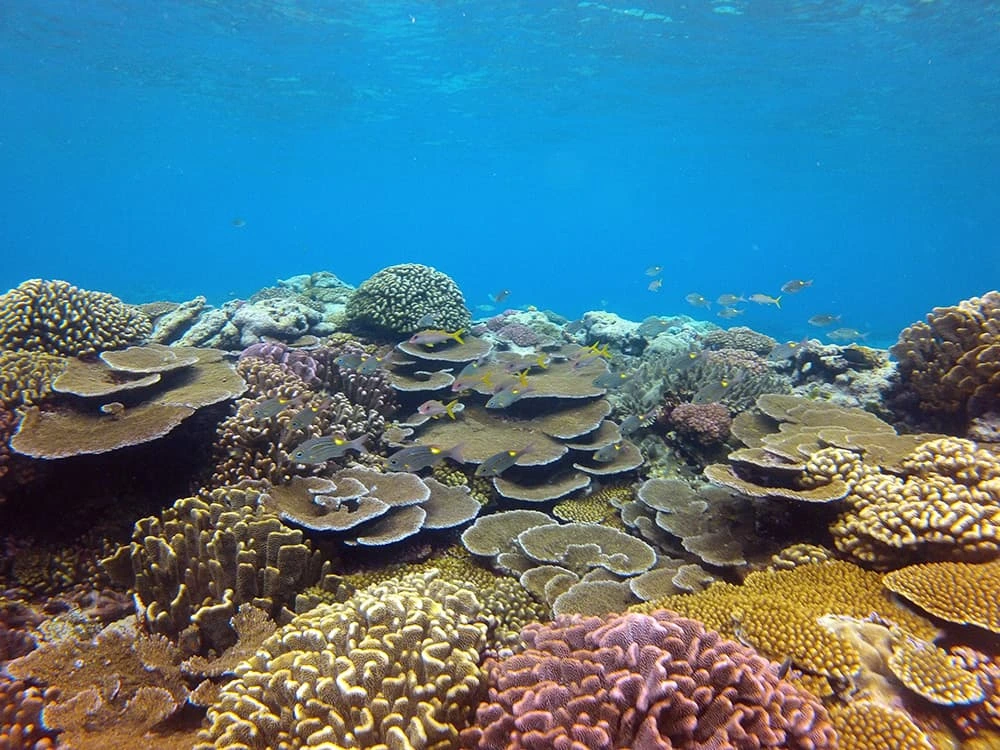
Coral habitat in National Marine Sanctuary of American Samoa. Illustrative NOAA photograph; not a current condition assessment or a WOL project. Photo: Wendy Cover/NOAA.
Protecting the ocean is a race to secure places that sustain life, food, and coastal communities while the pressures on them keep changing. The world has a clear destination: conserve at least 30 percent of marine and coastal areas by 2030. The difficult part is making protection work in the water—and making it durable for the people who depend on those places.
A global goal, with a substantial gap
Protected Planet’s October 2026 dashboard reports that protected areas and other effective area-based conservation measures cover 10.04 percent of the global marine area. Protected areas alone account for 9.82 percent. The distinction matters: the combined figure includes places where lasting biodiversity conservation is achieved even when conservation is not the primary management objective.
That leaves approximately 20 percentage points between reported combined coverage and the 30 percent goal. It is a large gap with only a few years remaining. But treating it purely as an exercise in adding square kilometers would miss much of the commitment.
Target 3 of the Kunming–Montreal Global Biodiversity Framework also calls for effective management, representative and connected ecosystems, fair governance, and respect for Indigenous peoples’ and local communities’ rights. A network must protect a meaningful range of ocean habitats and the connections between them. Its value cannot be established by area alone.
What does “protected” tell us?
A marine protected area can be at very different points in its development. The MPA Guide distinguishes a proposal from a designation, a site with active regulations, and one with ongoing monitoring and adaptive management. A public announcement is an important step, but it does not by itself establish that management is operating.
The same framework separates the stage of establishment from the strength of protection. Fully protected areas allow no impacts from extractive or destructive activities and minimize other manageable impacts. Highly protected areas permit only light extraction with low total impact and also minimize other manageable impacts. Other categories allow activities with greater impacts. The label “marine protected area” therefore does not mean that every site has the same rules or expected benefits.
For anyone assessing an announcement, the useful questions are specific. What habitat or species is the site intended to protect? Which damaging pressures will its rules address? When do those rules take effect, who implements them, and how will results be assessed? Those answers turn a promising headline into an understandable conservation proposition.
The people and resources behind the boundary
Research offers a reason to take the operating budget seriously. In a 2017 Nature study, David Gill and colleagues examined management and ecological performance across marine protected areas. Staff and budget capacity were the strongest predictors of conservation impact in their analysis. Areas with adequate staff capacity showed larger ecological effects than those without it.
That finding is an association across the sites studied, not a promise that a particular donation will produce a particular increase in fish. Its practical message is nevertheless clear: creating more protected space and providing the capacity to manage it need to advance together.
For a supporter, the less visible work may be especially useful: maintaining monitoring equipment, supporting agreed training, translating information for local users, or helping a qualified organization keep records. The site’s managers and communities should define the need. An attractive activity designed around a visitor’s availability can consume scarce staff time if it does not fit the work.
Fair governance also deserves attention before a project is celebrated. Who participates in decisions? Who carries restrictions or costs, and who receives benefits? The biodiversity framework makes rights and equity part of the goal. They belong in planning, funding, and evaluation from the beginning.
Protection has to work in a changing ocean
A boundary can help manage activities within it. It cannot keep warming water outside. The IPCC’s 2022 ocean assessment explains both the potential role of area-based protection in adaptation and the limits of existing protected areas against warming and marine heatwaves. Habitat protection and action on climate pressures need to proceed together.
Reefs make the stakes tangible. NOAA describes how they support marine life, fisheries, tourism, and coastal protection. It also identifies warming, pollution, sedimentation, and overfishing among the pressures they face. Different pressures require different responses; a single intervention cannot be assumed to address all of them.
Monitoring is therefore part of protection itself. Managers need to understand what is changing and whether their actions are helping. Repeated observations, clear methods, and records of management decisions are more informative than a single before-and-after photograph. Where conditions deteriorate despite local work, honest reporting helps identify the next decision instead of hiding the difficulty.
A useful role for company teams and individuals
Companies can begin with a place or ocean issue connected to their operations, workforce, or supply chain. Then ask an appropriate organization what support would be useful and feasible. A defined contribution to existing work is easier to evaluate than an expansive promise to “protect the ocean.”
Within WOL’s company-team format, a scoped 90-day program could organize an agreed contribution, employee learning, and a closing evidence report. Possible work must be confirmed with the relevant organization before it is offered. The program should identify responsibilities, costs, permissions, and what can realistically be documented within those 90 days.
A useful report might show funds transferred, training completed, or monitoring records accepted by the receiving project. Those are distinct from ecological recovery. Participation points and friendly team competition can recognize agreed contributions; they do not certify protected ocean area or establish biodiversity gains.
Individuals can learn about the protected waters nearest to them, follow local visitor guidance, and consider participation opportunities offered by authorized organizations. WOL’s free network provides a way to follow the Journal and explore participation. The corporate program offers a separate route for a company with a defined objective and an actionable next step.
Can we protect the ocean fast enough? The outcome is not settled. The useful response is to pursue greater coverage and stronger implementation together: choose important places, support the people responsible for them, respect local rights, and keep checking what the work achieves. That is a demanding ambition, but it gives businesses and individuals a concrete place to begin.
Put the plan into practice.
Explore a scoped 90-day corporate ocean program, with responsibilities and reporting agreed before work begins.
Explore the corporate programFor individual participation, join the free WOL network. For an evidence framework, read A practical ocean scorecard.