
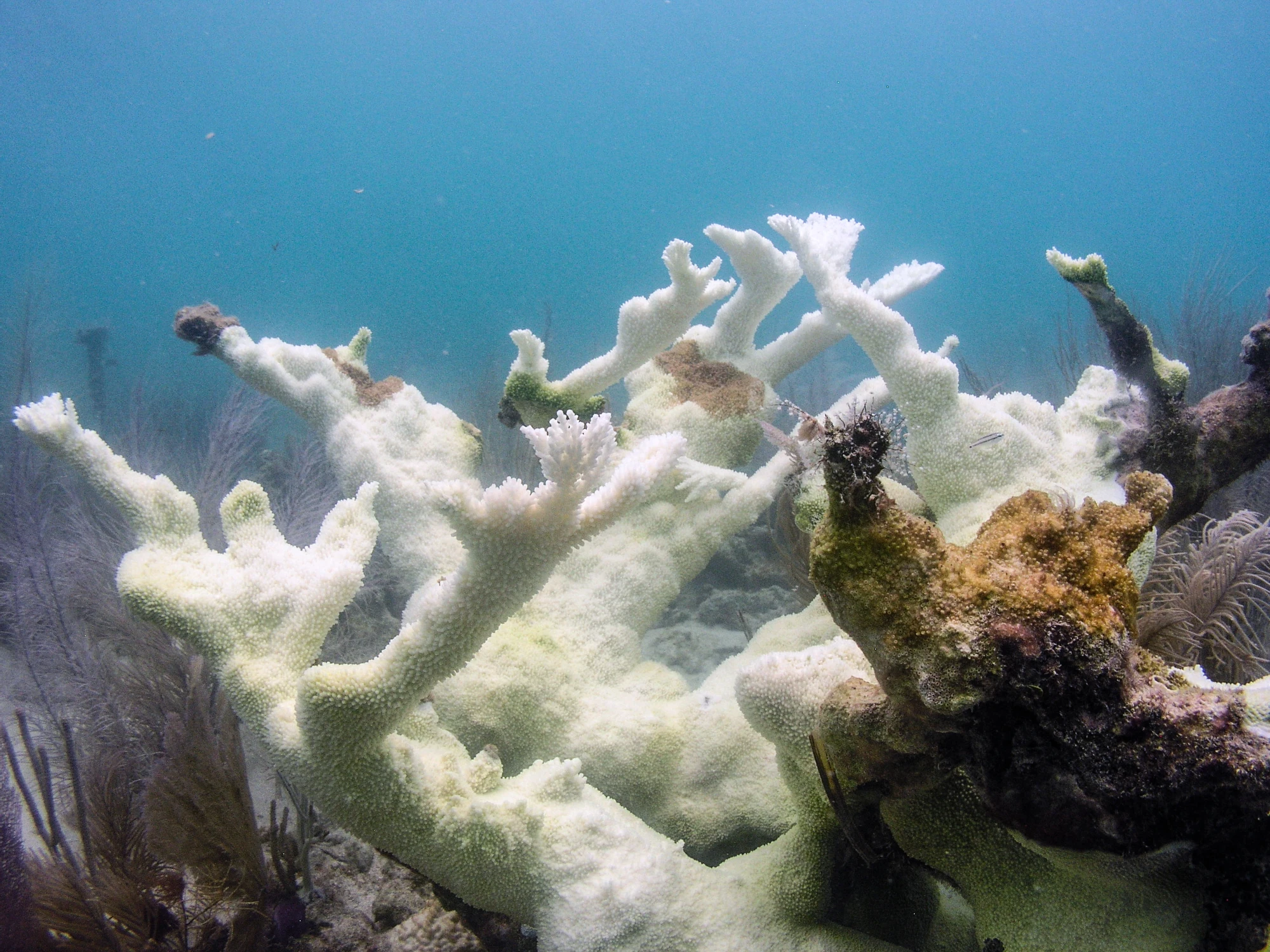
Bleached elkhorn coral in Dry Tortugas National Park during the summer 2023 ocean heatwave. Historical documentary photograph; not a current conditions report or WOL project. Photo: U.S. Geological Survey.
The ocean’s heat problem reaches well beyond the beach. It affects the waters that supply seafood, the reefs that protect shorelines, and the places where people live, work, and travel. Understanding it changes the question facing businesses and communities: how do we protect the systems we depend on while preparing for conditions that are already changing?
The heat we do not feel on land
NASA estimates that the ocean has absorbed about 90 percent of the excess heat associated with planetary warming over the past century. Water can store a great deal of energy, so a relatively small change in ocean temperature represents a substantial addition of heat. The sea has buffered warming in the atmosphere, but the energy has not disappeared.
The World Meteorological Organization’s assessment released on March 23, 2026 reported that heat stored in the upper 2,000 meters of the ocean reached a record in 2025. It also found that the rate of ocean warming during 2005–2025 was more than twice the rate during 1960–2005. Those are findings about accumulated heat, rather than the temperature of one beach on one afternoon.
Sea-surface temperature, ocean heat content, and marine heatwaves describe related but different things. Surface readings describe the uppermost water; heat content accounts for energy stored through a specified depth. Marine heatwaves are sustained periods of unusually warm water relative to the conditions normally expected in a place and season. A cooler month in one region does not establish that the global ocean has stopped gaining heat.
A global issue with unequal consequences
The ocean does not warm evenly. Currents move heat, different depths respond differently, and local conditions shape what marine life experiences. Woods Hole Oceanographic Institution describes consequences ranging from heatwaves and shifting species ranges to rising seas. The same global trend can therefore produce very different pressures along different coastlines.
Some consequences travel beyond coastal communities. NOAA Fisheries explains that changes in species distribution and productivity affect where fishing can happen and what boats catch. When fish move beyond a fleet’s practical reach, the disruption can extend to seafood businesses and the communities around them. For buyers, that makes the origin of seafood and the condition of the fishery more useful questions than a general claim that all seafood faces the same risk.
Warming water also expands. NASA identifies that expansion as a contributor to sea-level rise. For a coastal hotel, harbor, or community, higher background sea level matters because buildings and infrastructure were designed around particular conditions. Exposure depends on the location; a global average is a starting point for assessing risk, not a forecast for a specific property.
What reefs reveal about the stakes
Coral reefs make the connection between temperature, wildlife, and livelihoods especially visible. Heat stress can cause corals to lose the symbiotic algae on which they depend, leaving them pale or white. Bleaching is a serious stress response; it does not mean every affected coral is already dead. The USGS explains that recovery is possible if conditions improve, while prolonged bleaching can lead to starvation and mortality.
In its June 2, 2026 assessment, NOAA said the fourth global coral bleaching event likely concluded in mid-2025. From early 2023 through mid-2025, bleaching-level heat stress affected 84 percent of the world’s coral reef area. That figure describes exposure to heat stress, not the percentage of coral that died. NOAA also reported documented mass bleaching in at least 83 countries and territories.
NOAA notes that reefs support fisheries and tourism and help protect coasts from waves. Their condition consequently matters to people who may never enter the water. The end of a global bleaching event is not evidence that all reefs have recovered; the agency emphasizes continued monitoring and research into why some corals withstand heat better than others.
What credible progress looks like
The response has to address both the cause of warming and the capacity to cope with its effects. The IPCC’s ocean assessment links greenhouse-gas emissions to ocean warming and identifies roles for ecosystem-based adaptation and better management. Its wider assessment also warns that adaptation becomes less effective as warming increases. Protecting habitat and limiting future warming belong in the same conversation.
That gives local work a clear purpose without asking it to solve a planetary problem alone. A well-chosen project can support a habitat, improve information, or help a community prepare. Its value depends on what it actually achieves. A cleanup can address litter; it does not lower global ocean heat. Habitat restoration needs suitable conditions and sustained stewardship; it should not be described as a guaranteed defense against future heatwaves.
For readers evaluating a project, three questions help: what pressure is being addressed, who has the expertise to do the work, and what evidence will show progress? A photograph can make the work visible. A dated record, a clear method, and follow-up observations make its results understandable.
Where companies can make a useful contribution
Companies can begin by looking at their own relationship with the ocean: the seafood they purchase, the coastal places they operate in, or the communities connected to their business. That makes it easier to choose a relevant initiative and ask informed questions of a qualified delivery organization.
WOL’s company-team format offers a way to bring employees into that effort and create friendly competition around agreed participation. A team might support an identified monitoring need, contribute to a suitable habitat initiative, or help colleagues understand the ocean issues connected to their work. Each activity needs a confirmed recipient, useful scope, and realistic responsibilities before it is offered.
A scoped 90-day program can organize that contribution and report completed work. It cannot establish that ocean temperatures have fallen or that an ecosystem has recovered in three months. Keep company participation and completed commitments visible while reserving ecological claims for the evidence that supports them. That is how an ambitious global purpose becomes a practical role people can understand and sustain.
Put the plan into practice.
Explore a scoped 90-day corporate ocean program, with responsibilities and reporting agreed before work begins.
Explore the corporate programFor individual participation, join the free WOL network. For an evidence framework, read A practical ocean scorecard.